
In 1996 I was working on some projects that required me to model some characters to be exactly like some toys that I had. I needed to use a digitizer but there was no way that I could have afforded one. At that time I was working as a driver and a floor sweep at a truck equipment shop. I put a little thought into this problem and came up with a solution that I could build during my lunch hours (which lasted 30 minutes). I built this over the course of a week or so. I probably should have painted it but I was too excited to start using it so I didn't bother. It has been a long time since I used it last but I think that I calculated its accuracy to within 1/50th of a inch. That is pretty good.
The way that you use this device is to position the sharp point at the location that you wish to get a coordinate for. You then read measurements off of the rulers on the sharp point and the cross bar as well as an angle measurement off to the protractor. Depending on which way you want your coordinate system set up, one of the axes will correspond to the reading of the crossbar, and the other two can be derived by calculating a radius using the vertical ruler (with the sharp point) and using trigonometry (with the measured angle) to calculate your other two axises. Because doing the calculations one by one on a calculator would have been a pain, I wrote a quick program on my calculator that allowed you to input the angle and ruler measurement and then spit out the two coordinates. This sped things up, but still the whole process was still quite slow.
I would only recommend this sort of process to someone who is 'financially challenged' as I was. Overall, I don't think that this coordinate finder cost me more than about $15. The only things that I had to buy were the protractor and the rulers. I got the rest of the parts from our scrap bins at work.
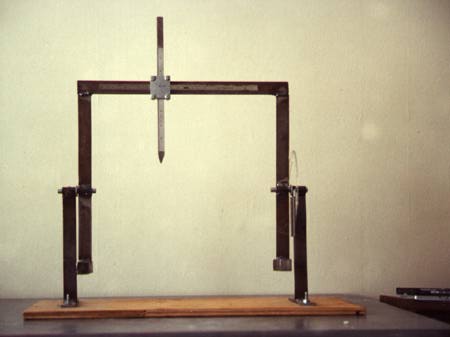
To clarify what you are looking at, the two vertical beams on the sides are mounted to the base while the rest of the mechanism swivels. Below is another angle so you can get a better idea of what you are looking at.
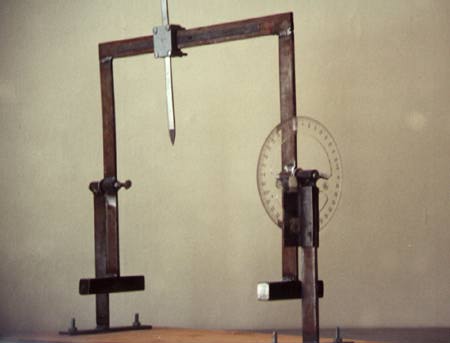
The big blocks of steel on the bottom of the center piece are counterweights so that the centerpiece would stay put without me having to lock its position with the thumb screws every time.
|